- December 11, 2025
- 6 min read
Why We Built a Unified Tool-Call Config Generator and Parser for Frontier Models
- FriendliAI developed a unified tool-call spec generator and parser to replace brittle, manual configurations with a system that automatically adapts to unique model grammars.
- This framework enables rapid onboarding for frontier models like GLM-4.6 and MiniMax-M2, handling diverse JSON, XML, or hybrid formats without rewriting parsing logic.
- The parser ensures reliable tool-calling behavior by constraining outputs to conform to user schemas, reducing errors in agentic workflows.
- Integrated with FriendliAI’s high-performance kernels, the system delivers 50%+ cost savings and enterprise-grade reliability for complex, tool-using AI applications.
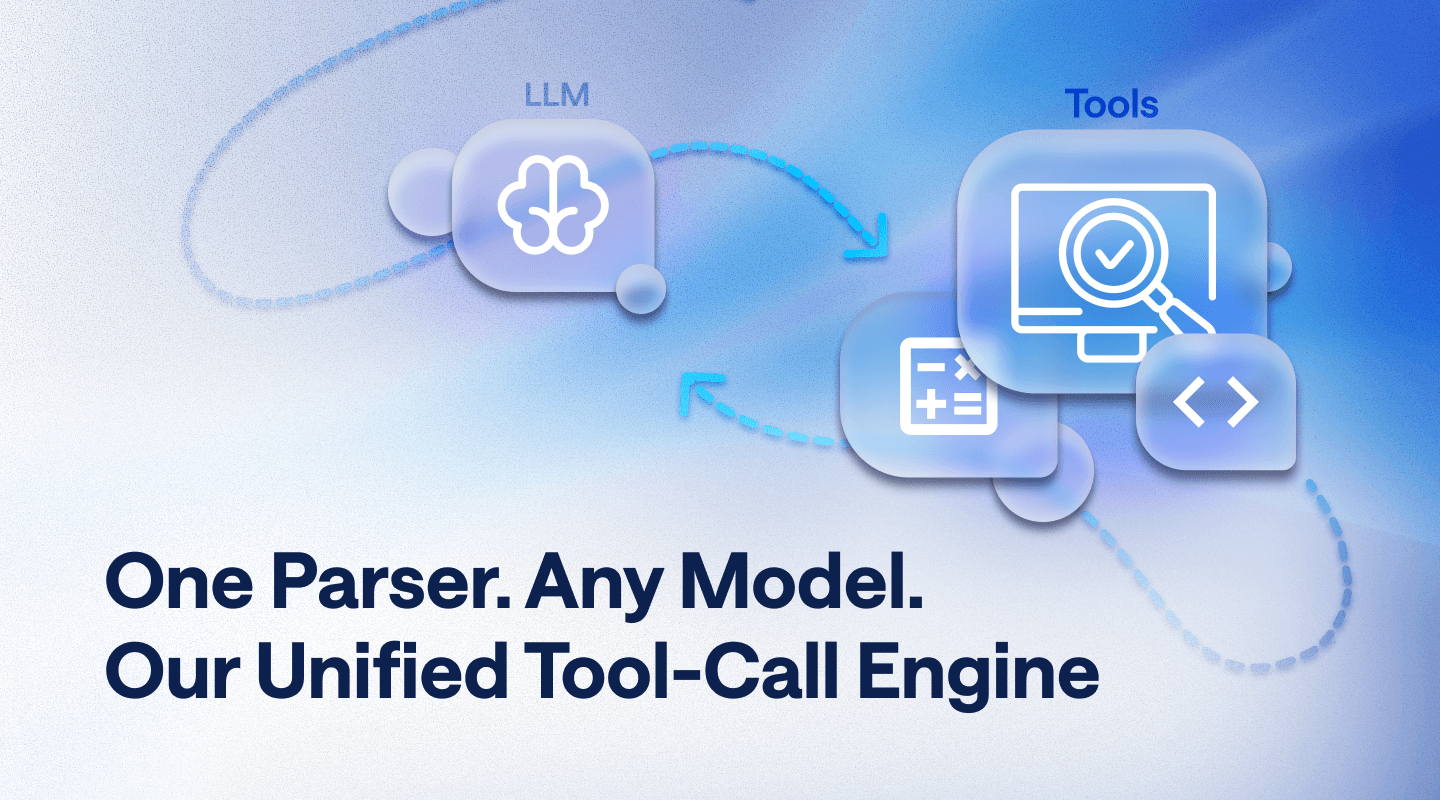
Frontier models are evolving at an unprecedented pace. Each new model release introduces distinct approaches to tool calling, output formatting, and instruction interpretation. Despite their advanced capabilities, the inconsistency of these tool-calling protocols poses persistent challenges for integration and standardization.
Conventional systems, such as vLLM, rely on manually maintained parsers: a parser must be prepared in advance for each model, which the system then retrieves when the model is selected. While functional, this approach imposes significant manual overhead and becomes increasingly unsustainable as the number and diversity of models grow.
To address these challenges, we developed a unified tool-call specification generator and tool-call parser. Rather than depending on pre-written configurations, our system automatically derives a tool-call specification from tool-calling outputs and builds a corresponding parser to ensure consistent, reliable tool-calling behavior across models. This approach allows us to support a wide range of models efficiently, handling each model’s unique grammar without the need to rebuild parsing logic for every release.
The Challenge
Tool calling has become a core requirement for agentic AI systems—but the lack of standardization across frontier models makes it difficult to maintain consistent behavior in production environments.
Each model family introduces its own variations:
- Different tool-calling identifiers
- Unique token patterns for arguments (JSON, XML, hybrid formats)
- Special rules for multi-step or nested tool calls
Manually crafting a parser for each model quickly becomes unscalable. Moreover, each parser has to support advanced capabilities—such as streaming parsing for responsive output and selective disabling to skip specific segments (e.g., reasoning sections). These requirements significantly increase the complexity of the task.
In other words, we needed a system that adapts automatically—without constantly rewriting rules.
Tool Call Spec Generator
To address these challenges, we first analyzed the tool-calling styles used across a wide range of models and defined a specification capable of representing this diversity. We then built an automatic specification generator that derives a model’s tool-call specification by analyzing its chat template. The resulting specification serves as the foundation for the formal grammar that defines the tool-calling syntax in our unified parser.
Unified Tool Call Parser
Building on the principles of our consolidated tool call specification, we developed a unified tool-call parser to flexibly build a formal grammar according to the spec. This parser is designed to:
- Reuse shared logic across models, eliminating the need to write new parsing code for each release
- Reduce errors by leveraging components already validated in production
This parser is leveraged in our system in two ways:
- Guided generation, which ensures the model produces valid tool-calling syntax and argument values that conform to a user-provided schema. This is achieved by continuously parsing the output and constraining the next allowable tokens.
- Tool-call parsing, which converts plain text into a structured representation containing tool names and their corresponding arguments.
The design allows new models to be integrated with minimal effort. Only when the tool-call specification must be expanded do we make targeted grammar updates, instead of re-architecting the parser entirely.
By abstracting model-specific differences, the unified parser ensures consistent, reliable tool-call behavior and streamlines the development workflow for our engineering teams.
Key Values
Combining the automatic spec generator with the unified parser provides clear advantages for our engineering teams:
- Faster onboarding of new models: Minimal setup enables quick support for GLM, Minimax, and others.
- Reliable behavior: Shared, well-tested parsing logic reduces errors and ensures consistency.
- Uniform tool-calling workflows: Model-specific tool callings are handled by a single reliable component.
- Consolidation of guided generation and tool call parsing: Consolidating the two essential features into a single component reduces duplication while increasing maintainability, consistency, and reliability.
Open-source parsers assume stable grammars, which frontier models rarely provide. By building on our internal framework, we gain:
- Flexibility: Adapt to new model grammars without rearchitecting.
- Reliability: Reuse validated components instead of rewriting logic.
- Maintainability: Centralize parsing logic while allowing model-specific rules to evolve independently.
Overall, the system’s extensibility, reliability, and maintainability enable engineers to integrate new models quickly and confidently.
Real-World Impact: Rapid Support for New Frontier Models
Our system came in very handy and proved its value when we recently added support for GLM-4.6, MiniMax-M2, and Ministral-3, the trending frontier models in agentic software development tasks. Despite each introducing its own tool-calling quirks, integration required only minimal effort. The spec generator automatically derived their tool-call formats from the rendered chat templates, and the unified parser built the corresponding grammars. Apart from a few small fixes, no additional engineering was needed, demonstrating how our approach enables fast, reliable onboarding of new frontier models to optimize the guided generation and tool call parsing logics.
FriendliAI Advantages
While the unified spec generator and parser strengthen our ability to support rapidly evolving frontier models, these capabilities are part of a broader platform designed to help teams run production-grade AI systems efficiently. FriendliAI provides high-performance, cost-efficient inference infrastructure that complements this tooling by ensuring models run optimally in real workloads.
- Faster, more efficient inference
Custom GPU kernels and optimizations—including Online Quantization and Speculative Decoding—deliver high throughput and efficiency for MoE models such as GLM-4.6, MiniMax-M2, and Ministral-3. - Scalable, cost-optimized serving
Predictable low latency, request-based autoscaling with fine-grained controls, and 50%+ GPU cost savings on Dedicated Endpoints. OpenAI-compatible APIs and support for multiple LoRA adapters per endpoint make integration and customization easy. - Built-in observability
Real-time metrics, detailed request logs, and usage insights enable faster debugging, performance tuning, and operational decision-making. - Enterprise-grade reliability and compliance
99.99% uptime SLA, SOC2-certified infrastructure, and global deployment options. FriendliAI Containers run on AWS EKS or on-premise environments, giving teams full privacy, governance, and data-locality control.
Conclusion
By developing a unified and extensible tool-call spec generator and parser, we have created a system capable of adapting to frontier models as they evolve, minimizing duplication, and accelerating development workflows for our engineering teams. This approach ensures that we can support the next generation of frontier models efficiently and reliably, regardless of the complexity or variability of their tool-calling grammars.
Similarly, we will continue to innovate and enhance our internal tooling to help our engineers work more efficiently and accelerate development cycles. By investing in robust, extensible infrastructure and exploring automation opportunities across our workflows, we ensure that our teams remain agile, productive, and fully equipped to respond to customer requests faster, deliver new capabilities more reliably, and provide a better overall experience as the AI landscape evolves.
Explore FriendliAI Today
Ready to run frontier models with reliable tool calling and production-grade performance? FriendliAI makes it easy to deploy, scale, and operate the latest open models without wrestling with brittle parsers or infrastructure complexity.
- Try it yourself in the Friendli Suite
Explore supported models, experiment with tool calling, and deploy endpoints in minutes.👉 https://friendli.ai/suite - Learn more about the FriendliAI platform
Discover how FriendliAI delivers high-performance, cost-efficient inference with enterprise-grade reliability.👉 https://friendli.ai
Whether you’re prototyping agentic workflows or running large-scale production systems, FriendliAI helps you move faster, confidently and efficiently.
Written by
FriendliAI Tech & Research
Share
General FAQ
Still have questions?
If you want a customized solution for that key issue that is slowing your growth, support@friendli.ai or click Talk to an engineer — our engineers (not a bot) will reply within one business day.

