Model description
- Model type: A 7B parameter GPT-like model fine-tuned on a mix of publicly available, synthetic datasets.
- Language(s) (NLP): Primarily English
- License: MIT
- Finetuned from model: mistralai/Mistral-7B-v0.1
Model Sources
At the time of release, Zephyr-7B-β is the highest ranked 7B chat model on the MT-Bench and AlpacaEval benchmarks:
Table with columns: Model, Size, Alignment, MT-Bench (score), AlpacaEval (win rate %)| Model | Size | Alignment | MT-Bench (score) | AlpacaEval (win rate %) |
|---|
| StableLM-Tuned-α | 7B | dSFT | 2.75 | - |
| MPT-Chat | 7B | dSFT | 5.42 | - |
| Xwin-LMv0.1 | 7B | dPPO | 6.19 | 87.83 |
|
In particular, on several categories of MT-Bench, Zephyr-7B-β has strong performance compared to larger open models like Llama2-Chat-70B:
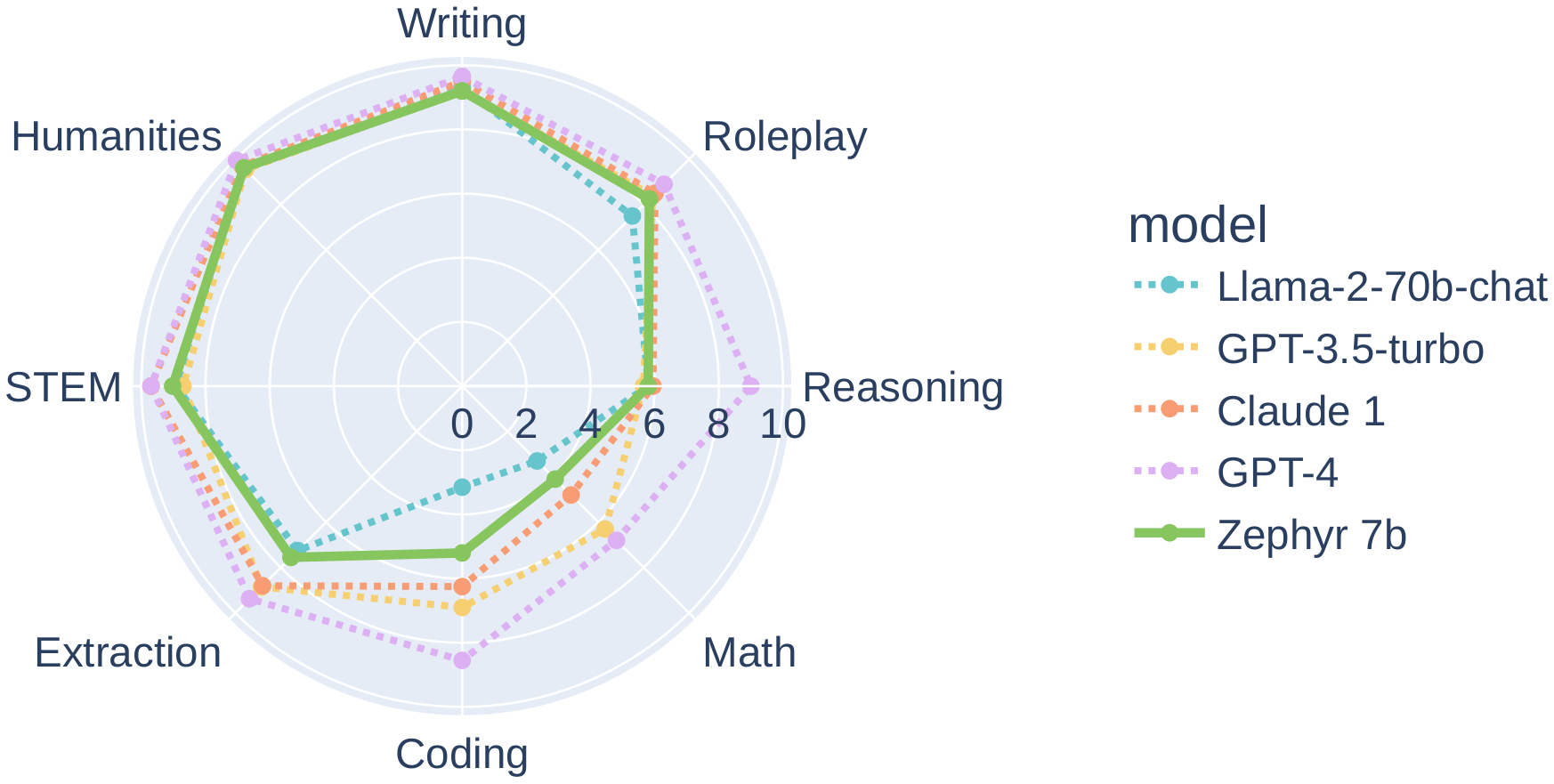
However, on more complex tasks like coding and mathematics, Zephyr-7B-β lags behind proprietary models and more research is needed to close the gap.
Intended uses & limitations
The model was initially fine-tuned on a filtered and preprocessed of the UltraChat dataset, which contains a diverse range of synthetic dialogues generated by ChatGPT.
We then further aligned the model with 🤗 TRL's DPOTrainer on the openbmb/UltraFeedback dataset, which contains 64k prompts and model completions that are ranked by GPT-4. As a result, the model can be used for chat and you can check out our demo to test its capabilities.
You can find the datasets used for training Zephyr-7B-β here
Here's how you can run the model using the pipeline() function from 🤗 Transformers:
import torch
from transformers import pipeline
pipe = pipeline("text-generation", model="HuggingFaceH4/zephyr-7b-beta", torch_dtype=torch.bfloat16, device_map="auto")
messages = [
{
"role": "system",
"content": "You are a friendly chatbot who always responds in the style of a pirate",
},
{"role": "user", "content": "How many helicopters can a human eat in one sitting?"},
]
prompt = pipe.tokenizer.apply_chat_template(messages, tokenize=False, add_generation_prompt=True)
outputs = pipe(prompt, max_new_tokens=256, do_sample=True, temperature=0.7, top_k=50, top_p=0.95)
print(outputs[0]["generated_text"])
Bias, Risks, and Limitations
Zephyr-7B-β has not been aligned to human preferences for safety within the RLHF phase or deployed with in-the-loop filtering of responses like ChatGPT, so the model can produce problematic outputs (especially when prompted to do so).
It is also unknown what the size and composition of the corpus was used to train the base model (mistralai/Mistral-7B-v0.1), however it is likely to have included a mix of Web data and technical sources like books and code. See the Falcon 180B model card for an example of this.
Training and evaluation data
During DPO training, this model achieves the following results on the evaluation set:
- Loss: 0.7496
- Rewards/chosen: -4.5221
- Rewards/rejected: -8.3184
- Rewards/accuracies: 0.7812
- Rewards/margins: 3.7963
- Logps/rejected: -340.1541
- Logps/chosen: -299.4561
- Logits/rejected: -2.3081
- Logits/chosen: -2.3531
Training hyperparameters
The following hyperparameters were used during training:
- learning_rate: 5e-07
- train_batch_size: 2
- eval_batch_size: 4
- seed: 42
- distributed_type: multi-GPU
- num_devices: 16
- total_train_batch_size: 32
- total_eval_batch_size: 64
- optimizer: Adam with betas=(0.9,0.999) and epsilon=1e-08
- lr_scheduler_type: linear
- lr_scheduler_warmup_ratio: 0.1
- num_epochs: 3.0
Training results
The table below shows the full set of DPO training metrics:
Table with columns: Training Loss, Epoch, Step, Validation Loss, Rewards/chosen, Rewards/rejected, Rewards/accuracies, Rewards/margins, Logps/rejected, Logps/chosen, Logits/rejected, Logits/chosen| Training Loss | Epoch | Step | Validation Loss | Rewards/chosen | Rewards/rejected | Rewards/accuracies | Rewards/margins | Logps/rejected | Logps/chosen | Logits/rejected | Logits/chosen |
|---|
| 0.6284 | 0.05 | 100 | 0.6098 | 0.0425 | -0.1872 | 0.7344 |
Framework versions
- Transformers 4.35.0.dev0
- Pytorch 2.0.1+cu118
- Datasets 2.12.0
- Tokenizers 0.14.0
Citation
If you find Zephyr-7B-β is useful in your work, please cite it with:
@misc{tunstall2023zephyr,
title={Zephyr: Direct Distillation of LM Alignment},
author={Lewis Tunstall and Edward Beeching and Nathan Lambert and Nazneen Rajani and Kashif Rasul and Younes Belkada and Shengyi Huang and Leandro von Werra and Clémentine Fourrier and Nathan Habib and Nathan Sarrazin and Omar Sanseviero and Alexander M. Rush and Thomas Wolf},
year={2023},
eprint={2310.16944},
archivePrefix={arXiv},
primaryClass={cs.LG}
}
If you use the UltraChat or UltraFeedback datasets, please cite the original works:
@misc{ding2023enhancing,
title={Enhancing Chat Language Models by Scaling High-quality Instructional Conversations},
author={Ning Ding and Yulin Chen and Bokai Xu and Yujia Qin and Zhi Zheng and Shengding Hu and Zhiyuan Liu and Maosong Sun and Bowen Zhou},
year={2023},
eprint={2305.14233},
archivePrefix={arXiv},
primaryClass={cs.CL}
}
@misc{cui2023ultrafeedback,
title={UltraFeedback: Boosting Language Models with High-quality Feedback},
author={Ganqu Cui and Lifan Yuan and Ning Ding and Guanming Yao and Wei Zhu and Yuan Ni and Guotong Xie and Zhiyuan Liu and Maosong Sun},
year={2023},
eprint={2310.01377},
archivePrefix={arXiv},
primaryClass={cs.CL}
}
Detailed results can be found here
Table with columns: Metric, Value| Metric | Value |
|---|
| Avg. | 52.15 |
| ARC (25-shot) | 62.03 |
| HellaSwag (10-shot) | 84.36 |
| MMLU (5-shot) | 61.07 |
| TruthfulQA (0-shot) | 57.45 |
| Winogrande (5-shot) | 77.74 |
| GSM8K (5-shot) | 12.74 |
| DROP (3-shot) | 9.66 |

