Serving
Use the serving repository, version v1.0.0:
halt95/qwen38-27b-3090s. It installs stock vLLM 0.30.0 from PyPI plus
five Python patches (hash-locked, nothing compiled at install) and serves this checkpoint at 262K context on dual RTX
3090s (TP=2) or quad (TP=4), with MTP K=3 and FP8 KV. Validated on sm_86 (Ampere) only.
git clone --branch v1.0.0 https://github.com/halt95/qwen38-27b-3090s && cd qwen38-27b-3090srelease/install-env.sh .venvHF_HUB_DISABLE_TELEMETRY=1 .venv/bin/hf download halt95/Qwen3.8-27B-W4A16-Merlin --local-dir ./ckpt(cd ckpt && sha256sum -c ../release/checkpoint.sha256)MODEL=$PWD/ckpt serve/serve.sh # serve/serve-tp4.sh for quad card
It is working when the log reads GPU KV cache size: 794,351 tokens (1,949,844 on quad card; with SPEC_K=1 the same
pins give 810,191 and 1,987,859; the pool is pinned in bytes, so any other number means a different setup) and Application startup complete, and a one-token generation on
127.0.0.1:8100 (model qwen38-27b) answers. Needs Linux x86_64, Python 3.13, a driver for CUDA 13.0, nvcc for
FlashInfer's JIT, and about 2.4 GiB of extra system RAM: the serving stack's own host-resident embedding patch
keeps the token-embedding table in pinned host RAM (1.184 GiB per GPU on dual card, 0.592 on quad card) and gives that VRAM
to the KV cache. Full requirements, troubleshooting and every knob are
in the repository's README. Both serve scripts expect working GPU peer-to-peer (P2P).
Measured (v1.0.0, reference host)
Table | |
|---|
| KV pool | 794,351 tokens on dual card (3 × 262K sessions at once); 1,949,844 on quad card (7 × 262K) |
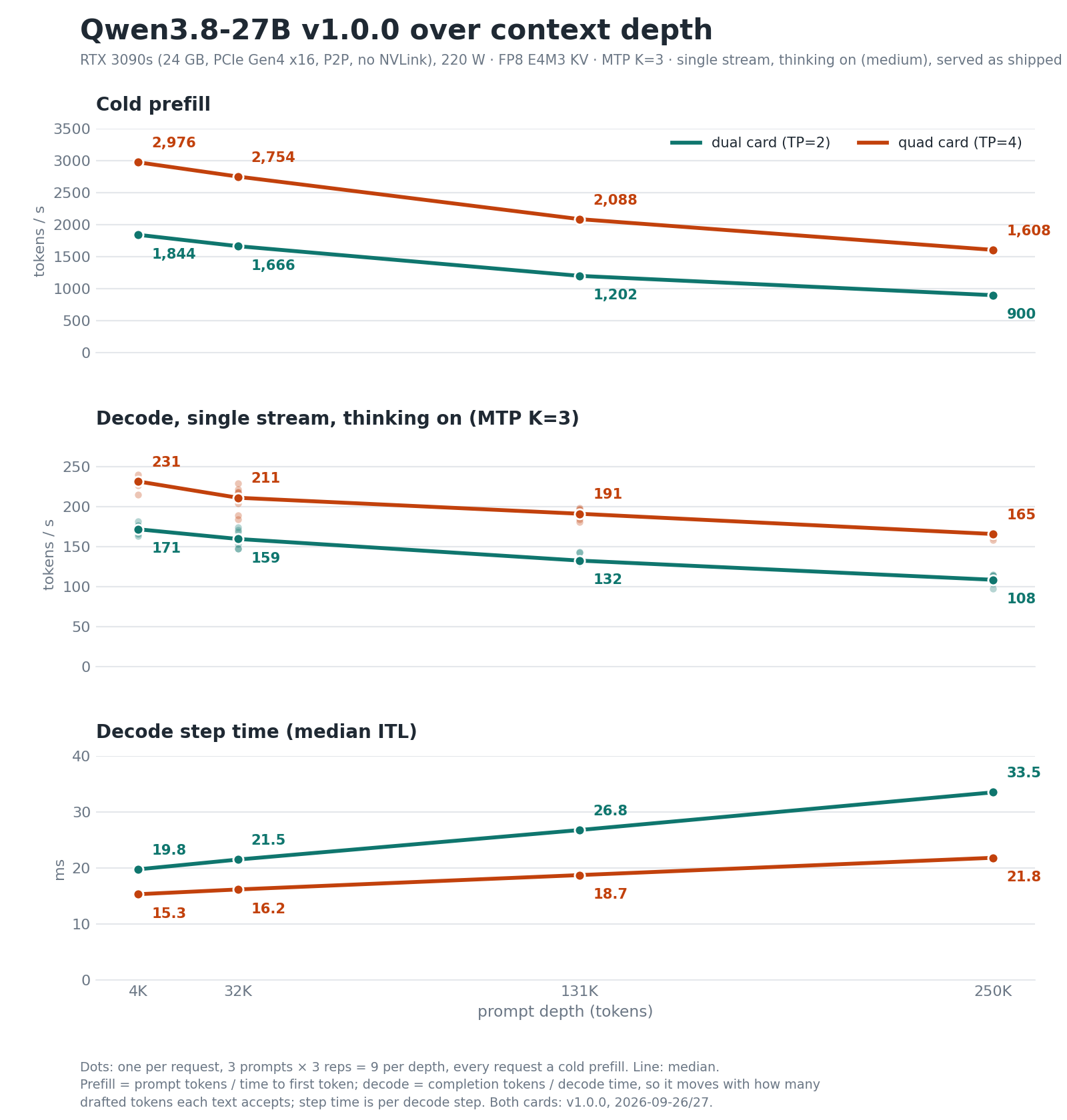
| single-stream decode step (median ITL), dual card, 4K / 32K / 131K / 250K | 19.8 / 21.5 / 26.8 / 33.5 ms, 3.4–3.5 tokens per step |
| same, quad card | 15.3 / 16.2 / 18.7 / 21.8 ms |
| single-stream decode, 4K / 32K / 131K / 250K | 171.4 / 159.3 / 132.3 / 108.3 tok/s dual card; 231.2 / 210.8 / 190.8 / 165.5 quad card |
| decode throughput, dual card, 1 / 2 / 4 / 8 / 32 streams (≈54-token prompts, 1,024 out) | 119.6 / 227.1 / 393.2 / 520.6 / 771.7 tok/s with K=3 (default); 106.6 / 208.4 / 390.1 / 644.3 / 946.4 with SPEC_K=1 (on two card pairs that differ by about 5 %) |
| decode throughput, quad card, 1 / 8 / 32 streams | 148.9 / 701.9 / 1,120.9 tok/s with K=3; 150.4 / 849.6 / 948.1 with |
Quality. Paired GSM8K-1319, same checkpoint, v1.0.0 against an earlier three-patch build of the serving stack
(thinking off, 512-token cap): 94.69 % vs 94.47 %, Δ +0.23 pp, 95 % CI [−0.96, +1.42] pp; the non-inferiority margin,
−2 pp, was fixed before the run: pass. Repetition loops: 0 genuine collapses in 108 long generations on v1.0.0 and
0 in 504 on earlier builds (including one with a BF16 head).
The bench cards are in the repository under benchmarks/.
How it was made
- The
lm_head and the MTP drafter head were quantized with GPTQ using input Hessians captured
from the served model; the drafter head was calibrated on drafter inputs. Codes are packed with
compressed-tensors pack_to_int32 in the signed range.
- FP8 E4M3 KV scales were calibrated per full-attention layer from observed absolute maxima,
with a 1.10 margin, on the philbert checkpoint before the head and drafter were quantised; that traffic included
the first 50 GSM8K test questions (activation maxima only).
- Calibration data: public benchmark prompts (ARC, MMLU-Pro, GPQA, GSM8K train split, HumanEval),
template-generated synthetic tasks and a small hand-written prompt set, together with the
model's own responses to them. No calibration data is distributed.
- The tools are in the serving repository under
quant/. The AWQ recipe for the base weights
is philbert's; see philbert440/Qwen3.8-27B-W4A16-AWQ.
Known behaviours and limits
All measurements are from one reference host (RTX 3090s, PCIe Gen4 x16, P2P-enabled driver, 220 W cap).
- sm_86 only. Other GPUs, non-P2P hosts and narrower PCIe links are unmeasured.
- Quad card: v1.0.0 measurements (performance at the earlier 2,010,034-token pin; the shipped pin re-verified), GSM8K-1319
paired against dual card 94.47 % vs 94.69 % (margin −2 pp: pass); its soaks ran on earlier builds.
- With vLLM 0.30 + MTP, prefix-cache reuse covers prompt prefixes, not a previous turn's generated tokens (a recompute
cost, not a correctness issue).
- A request reusing prefix-cache blocks can differ from a cold one at near-tied tokens; greedy output repeats for
identical requests.
- The base model can loop occasionally; none was seen in the v1.0.0 loop check.
- Soak-tested on earlier builds: 8 h on dual card (3,808 requests) and 2 h on quad card (999 requests) on the three-patch
build, 0 errors; the pre-release five-patch build 65 min / 35 min, 0 errors. No full-length soak on v1.0.0 itself.
Licence and attribution
Apache-2.0, like the base model and the AWQ checkpoint. Credit to Qwen (Alibaba Cloud) for
Qwen3.8-27B and to philbert for the AWQ checkpoint
philbert440/Qwen3.8-27B-W4A16-AWQ. The serving stack is
halt95/qwen38-27b-3090s (Apache-2.0); its
NOTICE credits vLLM, vLLM PR #47979, FlashInfer,
compressed-tensors and froggeric's chat template; this repository's own NOTICE covers the checkpoint. Sibling release for the MoE model:
halt95/qwen38-flash-next-3090s.