NVFP4 Quantization Details
Table | |
|---|
| Base model | Qwen/Qwen3.6-27B |
| Quantization | NVFP4 — weights FP4, activations FP4 (dynamic local), scales FP8 |
| Format | compressed-tensors (native vLLM support) |
| Tool | vllm-project/llm-compressor |
| Requires | NVIDIA Blackwell GPU (SM 120+), vLLM ≥ 0.19 |
What's Quantized / What's Not
The quantization strategy carefully preserves the most sensitive components in BF16 while aggressively compressing the compute-heavy stable layers:
Table with columns: Component, Precision, Reason| Component | Precision | Reason |
|---|
| FFN / MLP — all 64 transformer layers | NVFP4 | High parameter density, stable under quantization |
| Full-attention projections (q/k/v/o) — 16 GQA layers | NVFP4 | Standard attention, tolerant to 4-bit |
| DeltaNet / Linear-attention projections — 48 layers | BF16 | Gated linear recurrence is sensitive to numerical errors |
| Vision encoder — all 27 blocks + merger | BF16 | Vision tower preserved to maintain multimodal quality |
lm_head | |
The architecture of Qwen3.6-27B interleaves 3 × DeltaNet (linear attention) layers with 1 × full GQA attention every 4 layers (16 such groups × 4 = 64 layers total). Only the full-attention group and all FFN layers are quantized; the DeltaNet recurrent cores are untouched.
Quantization Config (llm-compressor)
# recipe.yamlQuantizationModifier: targets: [Linear] scheme: NVFP4 ignore: - lm_head # Vision encoder — all 27 blocks (attn + mlp) + merger - re:model\.visual\.blocks\.\d+\..* - model.visual.merger.linear_fc1 - model.visual.merger.linear_fc2 # DeltaNet / Linear-attention layers (layers 0–2, 4–6, 8–10, ..., 60–62) - re:model\.language_model\.layers\.\d+\.linear_attn\..*
Quick Start (vLLM)
vllm serve vrfai/Qwen3.6-27B-NVFP4 \ --max-model-len 8192 \ --gpu-memory-utilization 0.9 \ --dtype auto \ --trust-remote-code \ --tensor-parallel-size 2
For single-GPU Blackwell (e.g., RTX 5090 with 32 GB):
vllm serve vrfai/Qwen3.6-27B-NVFP4 \ --max-model-len 8192 \ --gpu-memory-utilization 0.92 \ --dtype auto \ --trust-remote-code
from transformers import Qwen3_5ForConditionalGeneration, AutoTokenizer model_name = "vrfai/Qwen3.6-27B-NVFP4"tokenizer = AutoTokenizer.from_pretrained(model_name, trust_remote_code=True)model = Qwen3_5ForConditionalGeneration.from_pretrained( model_name, torch_dtype="auto", device_map="auto", trust_remote_code=True,) messages = [{"role": "user", "content": "Explain quantization in one paragraph."}]text = tokenizer.apply_chat_template(messages, tokenize=False, add_generation_prompt=True)inputs = tokenizer(text, return_tensors="pt").to(model.device)outputs = model.generate(**inputs, max_new_tokens=512)print(tokenizer.decode(outputs[0][inputs.input_ids.shape[1]:], skip_special_tokens=True))
OpenAI-compatible API
from openai import OpenAI client = OpenAI(base_url="http://localhost:8000/v1", api_key="EMPTY") response = client.chat.completions.create( model="vrfai/Qwen3.6-27B-NVFP4", messages=[{"role": "user", "content": "Hello!"}], temperature=0.7, max_tokens=512,)print(response.choices[0].message.content)
Quantization Script
The recipes and scripts used to quantize this model can be found in the following repository:
Tested Environment
Table with columns: Component, Version| Component | Version |
|---|
| vLLM | 0.19.1 |
| Transformers | 5.6.0 |
| PyTorch | 2.10.0+cu128 |
| CUDA | 12.8 (nvcc 12.8.61) |
| llm-compressor | compressed-tensors 0.14.0.1 |
| GPU | 2× NVIDIA RTX 5090 (tensor-parallel-size 2) |
| OS | Ubuntu 24 |
Best Practices
Sampling parameters:
Table with columns: Mode, temperature, top_p, top_k, presence_penalty| Mode | temperature | top_p | top_k | presence_penalty |
|---|
| Thinking — general | 1.0 | 0.95 | 20 | 0.0 |
| Thinking — coding (WebDev) | 0.6 | 0.95 | 20 | 0.0 |
| Non-thinking / instruct | 0.7 | 0.80 | 20 | 1.5 |
Output length: Recommend max_new_tokens=32768 for most tasks; up to 81920 for complex math/coding benchmarks.
Thinking mode (enable via chat template):
text = tokenizer.apply_chat_template( messages, tokenize=False, add_generation_prompt=True, chat_template_kwargs={"enable_thinking": True},)
Credits
Below is the original model card from Qwen/Qwen3.6-27B:

[!Note]
This repository contains model weights and configuration files for the post-trained model in the Hugging Face Transformers format.
These artifacts are compatible with Hugging Face Transformers, vLLM, SGLang, KTransformers, etc.
Following the February release of the Qwen3.5 series, we're pleased to share the first open-weight variant of Qwen3.6. Built on direct feedback from the community, Qwen3.6 prioritizes stability and real-world utility, offering developers a more intuitive, responsive, and genuinely productive coding experience.
Qwen3.6 Highlights
This release delivers substantial upgrades, particularly in
- Agentic Coding: the model now handles frontend workflows and repository-level reasoning with greater fluency and precision.
- Thinking Preservation: we've introduced a new option to retain reasoning context from historical messages, streamlining iterative development and reducing overhead.
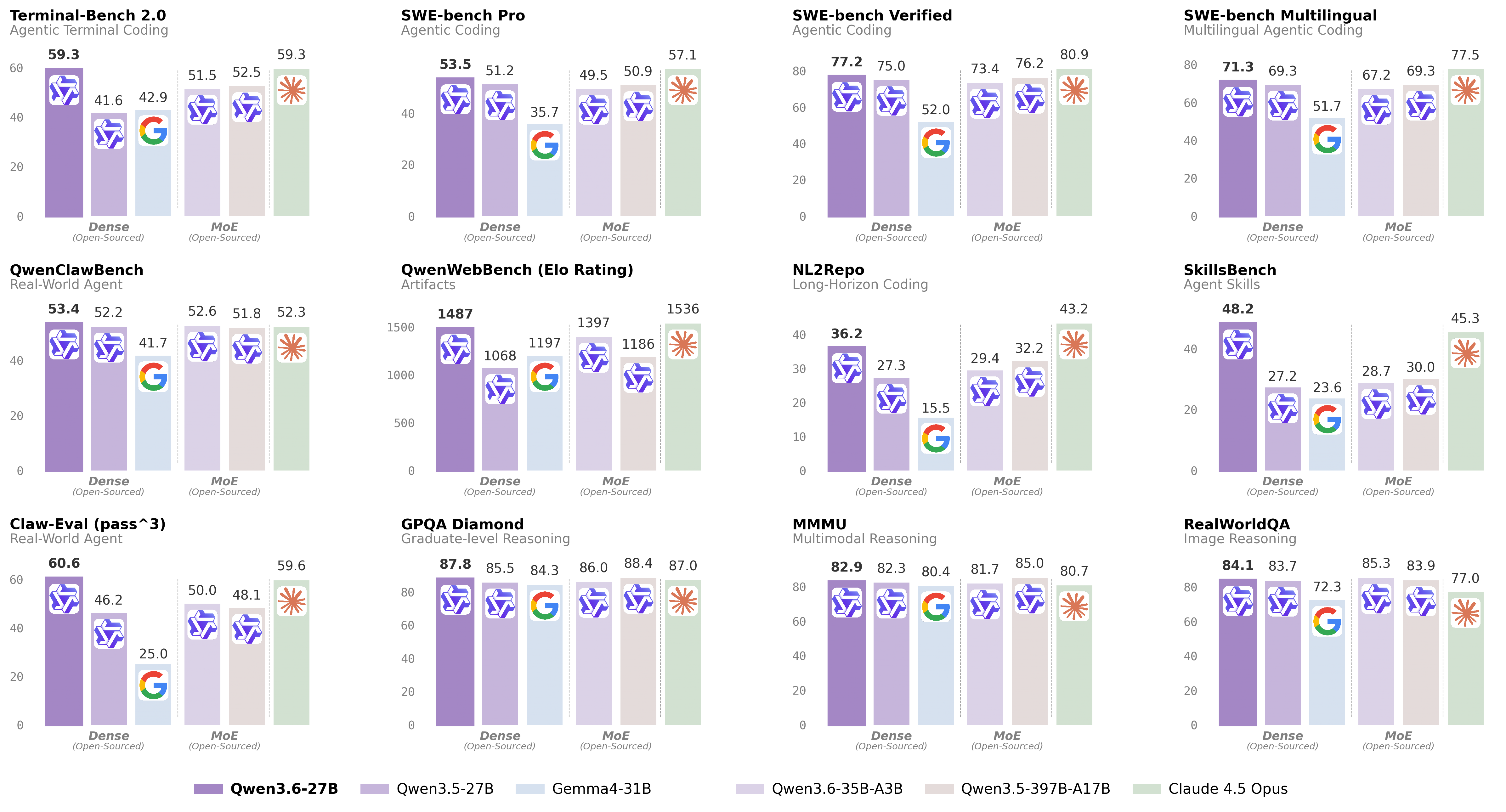
For more details, please refer to our blog post Qwen3.6-27B.
Model Overview
- Type: Causal Language Model with Vision Encoder
- Training Stage: Pre-training & Post-training
- Language Model
- Number of Parameters: 27B
- Hidden Dimension: 5120
- Token Embedding: 248320 (Padded)
- Number of Layers: 64
- Hidden Layout: 16 × (3 × (Gated DeltaNet → FFN) → 1 × (Gated Attention → FFN))
- Gated DeltaNet:
- Number of Linear Attention Heads: 48 for V and 16 for QK
- Head Dimension: 128
- Gated Attention:
- Number of Attention Heads: 24 for Q and 4 for KV
- Head Dimension: 256
- Rotary Position Embedding Dimension: 64
Citation
@misc{qwen3.6-27b, title = {{Qwen3.6-27B}: Flagship-Level Coding in a {27B} Dense Model}, author = {{Qwen Team}}, month = {April}, year = {2026}, url = {https://qwen.ai/blog?id=qwen3.6-27b}}