- June 6, 2026
- 5 min read
At What Scale Do Dedicated Endpoints Make Sense?
- LLM inference pricing generally falls into two models: pay-per-token and dedicated capacity.
- The most cost-effective option depends on your workload.
- Start with Model APIs, measure real usage, then move to Dedicated Endpoints when your workload justifies dedicated capacity.
Introduction
Pay-per-token pricing is often the easiest way to start building with LLMs. There is no infrastructure to manage, no GPUs to provision, and costs scale directly with token usage. But as traffic grows, the economics can change. At some point, continuing to pay per token may no longer be the most cost-effective option. For high-volume workloads, reserving dedicated GPU capacity can reduce unit costs while improving performance predictability. So, when does it make sense to move from pay-per-token pricing to dedicated GPUs?
This guide explains the two common pricing models for LLM inference, when each model makes sense, and how to evaluate the tradeoffs using FriendliAI’s Model APIs and Dedicated Endpoints as examples.
Two Pricing Models for LLM Inference
Most LLM inference products fall into one of two pricing models: pay-per-token or dedicated-capacity pricing. The key difference between the two is how costs scale.
- Pay-per-token cost scales with token consumption.
- Dedicated capacity costs are tied to reserved infrastructure. You pay for GPU capacity over time rather than for each token processed.
As a result, pay-per-token pricing is often a better fit for low-volume, bursty, or unpredictable workloads. Dedicated capacity becomes more attractive when traffic is steady, and GPU utilization is high.
FriendliAI offers both pricing models:
- Model APIs (pay-per-token)
- Dedicated Endpoints (dedicated capacity)
Neither model is universally better. The right choice depends on your workload.
Visualizing the cost trend
To illustrate how the two pricing models behave, we modeled a representative GLM-5.1 workload. We assume 10,000 input tokens and 500 output tokens per request, representing a typical enterprise GenAI application with a large retrieved context and relatively short responses. We also assume a 50% cache hit rate on input tokens. Under these assumptions, the effective Model API price is approximately $1.00 per million tokens.
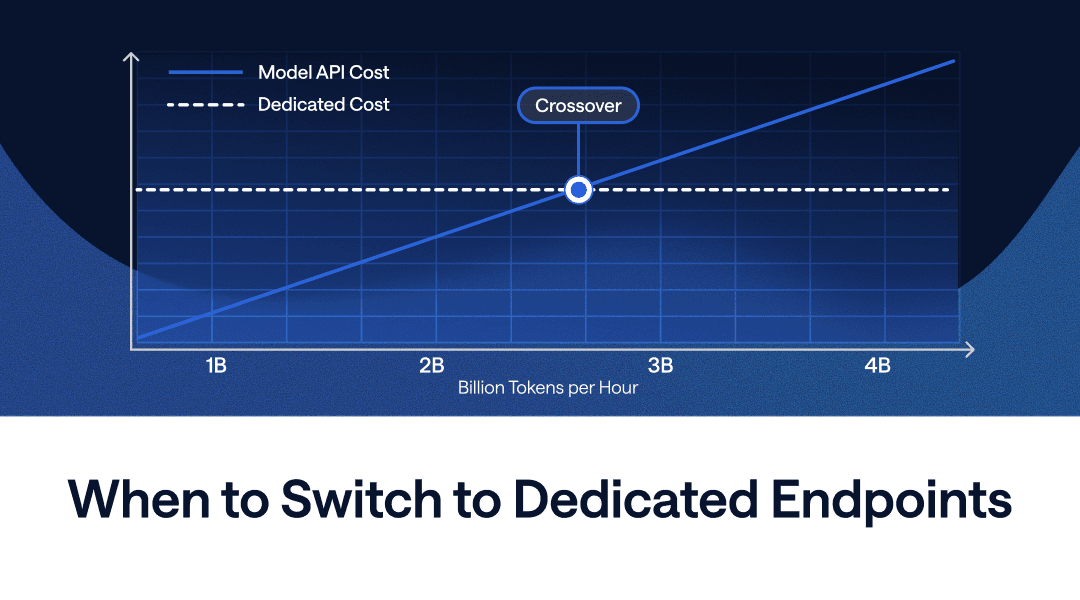
The figure below compares this pay-per-token cost curve with the fixed hourly cost of reserving 4 B200 GPUs, the minimum configuration required to serve GLM-5.1. As throughput increases, Model API costs scale linearly with token volume, while Dedicated Endpoint costs remain fixed because they are proportional to the number of GPUs.
The intersection between the two curves marks the crossover point. Below this point, Model APIs are more cost-effective because costs scale only with usage. Above it, Dedicated Endpoints become more economical because GPU capacity is utilized more efficiently.
These estimates also assume GPUs are running continuously. In practice, Dedicated Endpoints can automatically scale down or enter sleep mode when idle, reducing infrastructure costs and shifting the crossover point for workloads with variable traffic.
The most cost-effective deployment model depends on your use case. By understanding your workload, including token composition, cache utilization, concurrency, latency requirements, and traffic patterns, you can estimate where your workload falls on the curve and determine whether a Model API or Dedicated Endpoint offers better economics.
What to measure before you decide
Choosing between Model APIs and Dedicated Endpoints starts with understanding your workload. The following metrics have the biggest impact on cost and performance:
Tokens per request Measure the typical number of input and output tokens for each request. Token volume directly affects Model API costs and determines the throughput required from a Dedicated Endpoint.
Throughput and concurrency Measure request rate and peak concurrency. Workloads with sustained throughput are generally better candidates for dedicated capacity, while bursty workloads can benefit from the elasticity of Model APIs.
Traffic patterns Understand when traffic occurs and how much it fluctuates. This is particularly important for Dedicated Endpoints because autoscaling and sleep mode can significantly reduce infrastructure costs during idle periods.
Latency requirements Define acceptable TTFT, TPOT, and end-to-end response times. Latency requirements often influence infrastructure decisions just as much as cost. A deployment optimized for maximum throughput may not deliver the response times required by your application.
These metrics determine both the economics and performance characteristics of your deployment. The better you understand your workload, the easier it becomes to identify the right operating point and choose the appropriate pricing model.
Switching to Dedicated Endpoints
FriendliAI makes migration straightforward. Both products expose an OpenAI-compatible API, so switching requires only updating the base URL and model ID.
In Dedicated Endpoints, you can monitor Cost Per Million Tokens ($) in the Metrics tab. Although billing is based on GPU usage time, this metric converts your actual GPU usage and token volume into an effective per-million-token cost.
This allows you to directly compare Dedicated Endpoint efficiency with Model API pricing and verify whether dedicated capacity is delivering better economics for your workload. In the example above, the effective cost is approximately $0.64 per million tokens, significantly lower than the equivalent GLM-5.1 Model API input token price of $1.40 per million tokens.
Beyond cost, migrating to Dedicated Endpoints delivers additional benefits:
- Predictable latency and SLAs - Reserved GPUs remove the noise of shared infrastructure.
- Model flexibility - Deploy your own fine‑tuned or LoRA models.
- Operational visibility - Access request and response logs for debugging.
Make your switch today
There is no universal crossover point between Model APIs and Dedicated Endpoints. The right choice depends on your workload. Model APIs are ideal for experimentation and variable traffic, while Dedicated Endpoints become more cost-effective as utilization increases and workloads become predictable. The best way to choose between them is to measure your workload, benchmark both options, and make the decision using real usage data.
If you are interested in exploring FriendliAI further:
- Model APIs (Serverless) we support: https://friendli.ai/model?products=SERVERLESS
- Pricing for Dedicated Endpoint: https://friendli.ai/docs/guides/dedicated-endpoints/pricing
Written by
FriendliAI Tech & Research
Share
General FAQ
Still have questions?
If you want a customized solution for that key issue that is slowing your growth, support@friendli.ai or click Talk to an engineer — our engineers (not a bot) will reply within one business day.