- June 4, 2026
- 4 min read
One Benchmark Is Not Enough to Choose Your Inference Provider
- Single benchmark results can be misleading when evaluating inference providers because latency and throughput vary across operating conditions.
- Pareto fronts reveal the optimal latency-throughput trade-offs available across different inference configurations.
- Different workloads require different operating points, from latency-sensitive chat applications to throughput-oriented batch workloads.
- A provider that wins at one benchmark point may not be the best choice for your workload and SLA requirements.
- To choose the best inference provider for your workload, compare Pareto fronts rather than relying on isolated benchmark results.
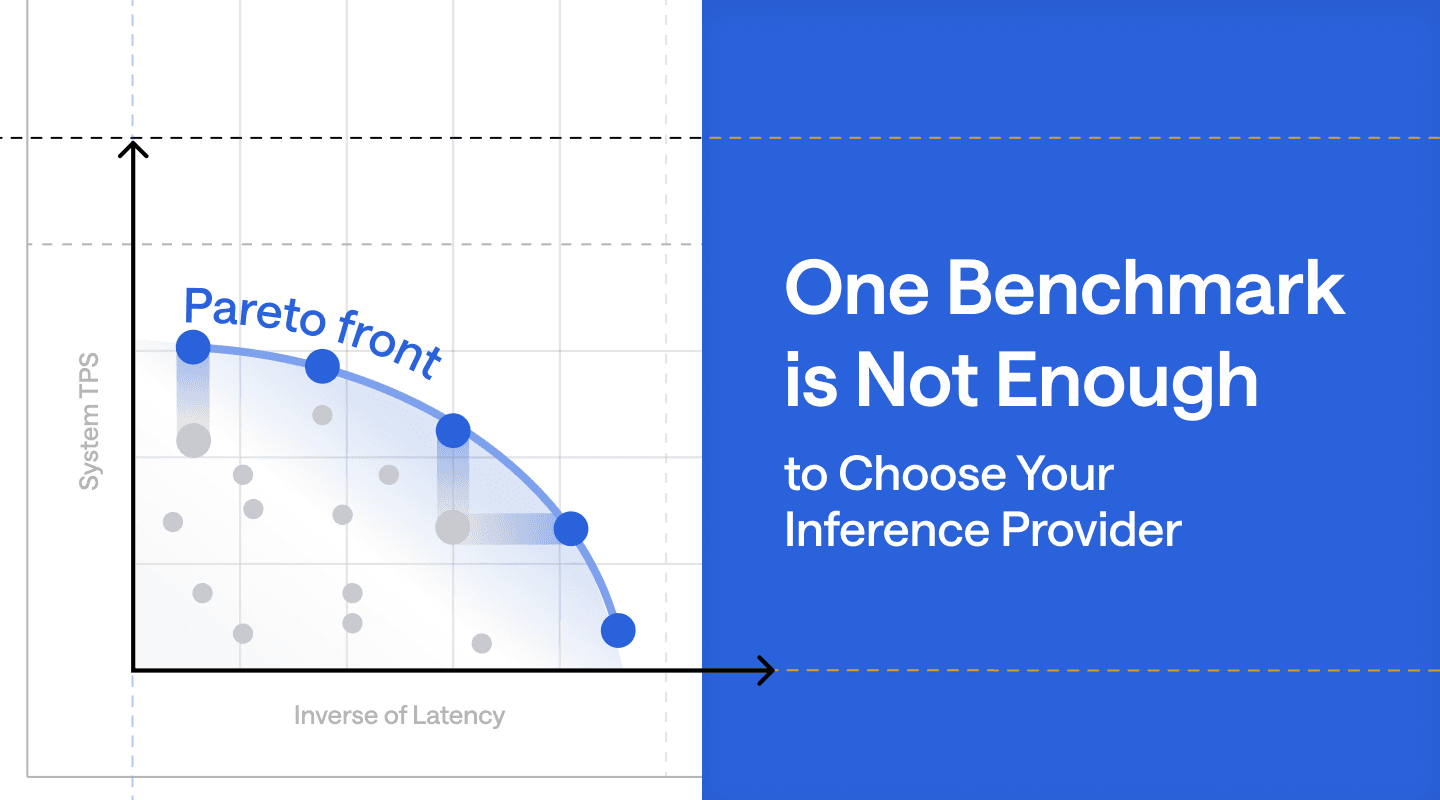
Teams often compare inference providers by focusing on a single benchmark result, such as the lowest Time to First Token (TTFT) or the highest throughput. While intuitive, this approach overlooks the broader trade-offs that determine real-world inference performance. Production inference workloads do not operate under one fixed condition. Latency requirements, traffic patterns, and throughput targets vary across applications. A provider that performs best at one benchmark point may not be the best choice for your workload. To make informed decisions, you need to look beyond individual benchmark results. You need to compare each provider’s Pareto front and choose the operating region that best satisfies your Service Level Agreement (SLA) constraints.
Why a Single Benchmark Point Is Not Enough
A single number cannot describe Large Language Model (LLM) inference performance. Latency and throughput depend on the operating conditions under which they are measured, including factors such as hardware configuration and batching strategy. As a result, every benchmark reflects performance under a specific operating condition rather than the full range of latency-throughput trade-offs.
For example, a provider may achieve the best throughput at a latency of 5 seconds. If your application requires responses within 1 second, that benchmark result is irrelevant. A benchmark point shows how a system performs under one operating condition, but not how it performs across the range of conditions required by real applications. For production workloads, the more important question is not whether a provider wins a particular benchmark, but how efficiently it operates across the conditions that matter to your SLA.
What the Pareto Front Reveals
In a multi-objective optimization problem, the Pareto front represents the set of optimal trade-offs where no objective can be improved without degrading at least one other objective. Solutions on the frontier are considered efficient because no better alternative exists that simultaneously improves all objectives.
In LLM inference, the Pareto front represents the most efficient latency-throughput trade-offs an inference provider can achieve. It is constructed by measuring performance across a range of operating configurations while varying parameters such as batch size and concurrency. Each measurement yields a latency-throughput pair, which is plotted on a latency-throughput graph. Dominated configurations are removed, and the remaining non-dominated points form the Pareto front.
Each point on the Pareto front is Pareto-optimal, meaning that no other measured configuration achieves better performance across all objectives. Points below the Pareto front are dominated by superior alternatives, as shown in Figure 2. The interpretation of the frontier, however, depends on how latency and throughput are defined. Throughput may be measured as requests per second (RPS) or tokens per second (TPS), while latency may be measured using metrics such as p95 latency or p95 time-to-first-token (TTFT). Meaningful Pareto front comparisons, therefore, require consistent definitions of latency and throughput.
Moving along the frontier reveals the throughput achievable under different latency constraints. Rather than highlighting performance under a single operating condition, the Pareto front reveals the full set of optimal operating points available to a provider. Figure 3 illustrates why this distinction matters.
At the highlighted benchmark point, Provider A appears superior because it achieves higher throughput at the same latency. However, comparing the full Pareto front reveals a different picture. Across a broader range of operating conditions, Provider B may offer better latency-throughput trade-offs. This is why a single benchmark result is often insufficient for evaluating inference performance. The Pareto front provides a more complete view of how a provider performs across the operating conditions that matter to real workloads.
Different Workloads Choose Different Points on the Front
There is no single ‘correct operating’ point on a Pareto front. Different workloads prioritize different objectives, so they choose different points on the same frontier.
Latency-sensitive workloads such as real-time chat applications and voice agents prioritize responsiveness. These applications may sacrifice some throughput to keep TTFT and end-to-end latency low. In contrast, throughput-oriented workloads such as batch generation and summarization are less sensitive to individual request latency and may prefer operating points that maximize throughput. Other applications, such as enterprise search and knowledge assistants, often fall between these extremes and require a balance between latency and throughput.
Different workloads care about different regions of the Pareto front. As a result, the key question is not which provider wins a particular benchmark, but which provider delivers the best Pareto front for your model, workload, and SLA requirements. Rather than relying on a single benchmark result, compare Pareto fronts across the operating conditions that matter to your application and identify the provider that delivers the strongest latency-throughput trade-offs for your workload.
Evaluate the Full Pareto Front with FriendliAI
FriendliAI helps customers benchmark realistic workloads, evaluate Pareto fronts across multiple operating conditions, and identify the configurations that best satisfy their SLA requirements.
Benchmark your workload, compare Pareto fronts, and identify the operating point that best matches your SLA requirements with FriendliAI.
🔍 Discover the best latency-throughput trade-offs for your workload with FriendliAI
🏃 Run your workload on Friendli Suite
Written by
FriendliAI Tech & Research
Share
General FAQ
Still have questions?
If you want a customized solution for that key issue that is slowing your growth, support@friendli.ai or click Talk to an engineer — our engineers (not a bot) will reply within one business day.