- September 8, 2026
- 5 min read
GLM-5.3 and GLM-5.3-Flash Lower Cost per Task in Different Ways
- Both GLM-5.3 and GLM-5.3-Flash beat GLM-5.2 on accuracy at a lower cost per task across three agentic benchmarks.
- Flash's savings come from cheaper tokens; GLM-5.3 is priced the same as GLM-5.2 and still costs less.
- Normalize token prices and the ranking flips: GLM-5.3 becomes the cheapest, Flash the most expensive.
- GLM-5.3 gets there with 12–45% fewer agent turns, depending on the benchmark.
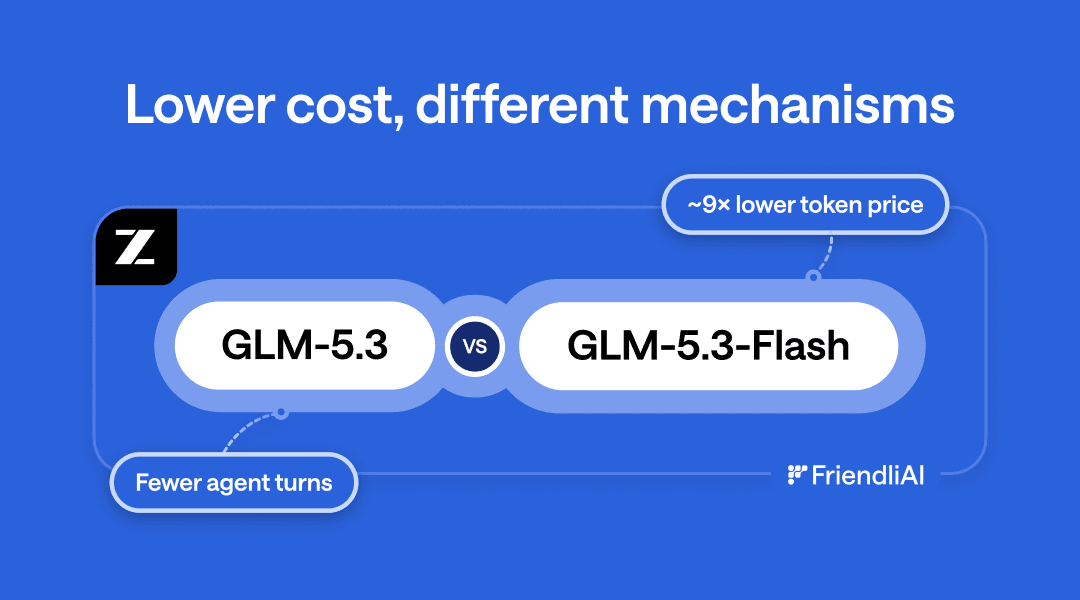
GLM-5.3 and GLM-5.3-Flash both achieve higher accuracy than GLM-5.2 while reducing the average cost per task across three agentic software benchmarks. However, their savings arise from different mechanisms. GLM-5.3-Flash benefits primarily from lower token prices, whereas GLM-5.3 achieves lower task-level costs at the same token prices as GLM-5.2 by completing tasks through shorter agent trajectories. We compare benchmark accuracy, token usage, and problem-solving trajectories to distinguish these two sources of cost reduction.
Because actual cost combines token prices with trajectory behavior, it does not directly reveal how efficiently a model uses those tokens. We therefore also report a normalized cost: what each task would have cost if every model charged the same price per input token. Under this normalization, GLM-5.3 becomes the lowest-cost model, replacing GLM-5.3-Flash at the top of the ranking. This reversal reveals two distinct paths to lower agent cost: GLM-5.3-Flash benefits primarily from cheaper tokens, whereas GLM-5.3 reduces the cost of the trajectory itself.
Can You Tell Which Model Built Each App?
Before diving into the benchmark results, compare the models yourself. We gave GLM-5.2, GLM-5.3, and GLM-5.3-Flash the same one-shot prompts to build three different applications:
- Excel: A spreadsheet experience with editable cells, formulas, formatting, and charts. Compare how accurately each model reproduces spreadsheet behavior and how polished the overall interface feels.
- App Store: A site for exploring mobile applications. Look for differences in navigation, category organization, detail views, and interactive elements.
- Cross-the-road Game: A playable arcade game that challenges you to guide a character across roads and obstacles. Pay attention to controls, movement, collision behavior, and animations.
Explore the applications below and rank them based on overall quality and functionality. Try clicking, scrolling, dragging, and playing! Submit your ranking to see the results at the end of the blog.
Higher Accuracy at a Lower Cost per Task
Token prices alone do not determine the cost of running a coding agent. Completing a task may require multiple model calls as the agent inspects the environment, modifies its solution, and responds to intermediate results. Cost per task captures this full trajectory by summing the tokens across all calls. We compare this cost with task accuracy to determine whether lower cost comes at the expense of task performance or accompanies better results.
| Model | Input | Cached input | Output |
|---|---|---|---|
| GLM-5.2 | $1.40 | $0.26 | $4.40 |
| GLM-5.3 | $1.40 | $0.26 | $4.40 |
| GLM-5.3-Flash | $0.15 | $0.03 | $0.50 |
Table 1. Token prices for each model. Prices are in USD per 1 million tokens.
We evaluated GLM-5.3, GLM-5.3-Flash, and GLM-5.2 with maximum reasoning budget on SWE-bench Verified, Terminal-Bench 2.1, and a 300-task subset of CyberGym. For each task, we recorded the benchmark outcome and total token usage across all model calls in the agent trajectory. We define accuracy as the percentage of attempted tasks completed successfully and calculate each task’s cost using the token prices in Table 1.
Figure 1. Accuracy and mean cost per task. GLM-5.3(red) and GLM-5.3-Flash(blue) both score higher and cost less compared to GLM-5.2(gray). Switch tabs at the top to compare GLM-5.3 and GLM-5.3-Flash against GLM-5.2.
Both newer models achieve higher accuracy than GLM-5.2 while incurring a lower mean cost across all three benchmarks. GLM-5.3 achieves the highest accuracy on SWE-bench Verified and Terminal-Bench 2.1, whereas GLM-5.3-Flash achieves the highest on CyberGym and the lowest mean cost on every benchmark. These costs, however, reflect both the models’ token prices and the trajectories they produce. The next section separates these effects by normalizing the overall price difference between the models.
Efficient Agent Trajectories Reduce Cost per Task
The costs in Figure 1 depend on the number and types of tokens used, as well as their prices. To make usage easier to compare, we ask: what would the same recorded tasks cost if every model charged the same input-token price? To answer it, we divide each model’s three prices in Table 1 by its own input-token price. This sets every model’s input price to 1.00× and expresses its cached-input and output prices as multiples of that baseline (Table 2). For example, GLM-5.2’s output price becomes 3.14× ($4.40 ÷ $1.40). These ratios are nearly identical across the three models, with one exception: GLM-5.3-Flash’s output price is 3.33× rather than 3.14×, giving its output tokens slightly more weight under this normalization.
We then recompute the cost of each recorded task using these ratios and report the results relative to GLM-5.2 (Figure 2). These normalized costs measure weighted token usage per task rather than actual spending. They remove the overall input-price difference while preserving each model’s relative prices for cached input and output.
| Model | Input | Cached input | Output |
|---|---|---|---|
| GLM-5.2 | 1.00x | 0.19x | 3.14x |
| GLM-5.3 | 1.00x | 0.19x | 3.14x |
| GLM-5.3-Flash | 1.00x | 0.20x | 3.33x |
Table 2. Each model’s prices from Table 1 divided by its own input price, so that every model starts from an input price of 1.00×. These ratios replace actual prices when computing normalized cost per task.
After normalization, GLM-5.3 has a lower mean normalized cost per task than both GLM-5.2 and GLM-5.3-Flash across all three benchmarks. GLM-5.3-Flash has the highest normalized cost on Terminal-Bench 2.1 and CyberGym, despite having the lowest actual cost. In other words, once the price difference is removed, Flash spends more on a task than either of the other models, and GLM-5.3 spends the least. GLM-5.3-Flash’s cost advantage comes primarily from lower token prices, whereas GLM-5.3’s advantage comes from how efficiently it completes tasks. To understand this trajectory's efficiency, we compare the number of agent turns per task and the number of output tokens generated per turn in Figure 3.
GLM-5.3 uses fewer turns on average across all three benchmarks, with approximately 45% fewer turns on SWE-bench Verified, 12% fewer on Terminal-Bench 2.1, and 40% fewer on CyberGym. By reaching an outcome in fewer interaction cycles, GLM-5.3 accumulates fewer tokens over the full trajectory and reduces the cost per task.
What You May Have Missed
Now that you know how the models compare in terms of accuracy, cost, and agent trajectories, revisit their applications. Some of the most interesting differences are easy to overlook during the initial ranking, like functional details, unexpected interactions, and a hidden easter egg.
Evaluate Coding Models by Cost per Task
GLM-5.3 and GLM-5.3-Flash demonstrate why token prices alone cannot explain the cost of running a coding agent. GLM-5.3-Flash achieves the lowest observed cost per task, largely due to its lower token prices. GLM-5.3 offers no pricing advantage over GLM-5.2, yet it completes tasks at a lower cost by using fewer tokens over shorter agent trajectories. Evaluating accuracy and cost across the entire task, therefore, reveals efficiency differences that per-token pricing misses.
GLM-5.3 and GLM-5.3-Flash are both available with day-0 support through FriendliAI Model APIs. → Try GLM-5.3 and GLM-5.3-Flash on FriendliAI
Written by
FriendliAI Tech & Research
Share
General FAQ
Still have questions?
If you want a customized solution for that key issue that is slowing your growth, support@friendli.ai or click Talk to an engineer — our engineers (not a bot) will reply within one business day.