- September 18, 2026
- 9 min read
When Open Models Beat Astra and Fable and When They Don’t?
- Open-weight models can deliver comparable or better accuracy at much lower cost.
- The best model depends on the workload, not a single benchmark score.
- GLM-5.3 and Kimi K3 also performed well on open-ended design tasks.
- Compare quality, speed, and cost on your own workloads before choosing a model.
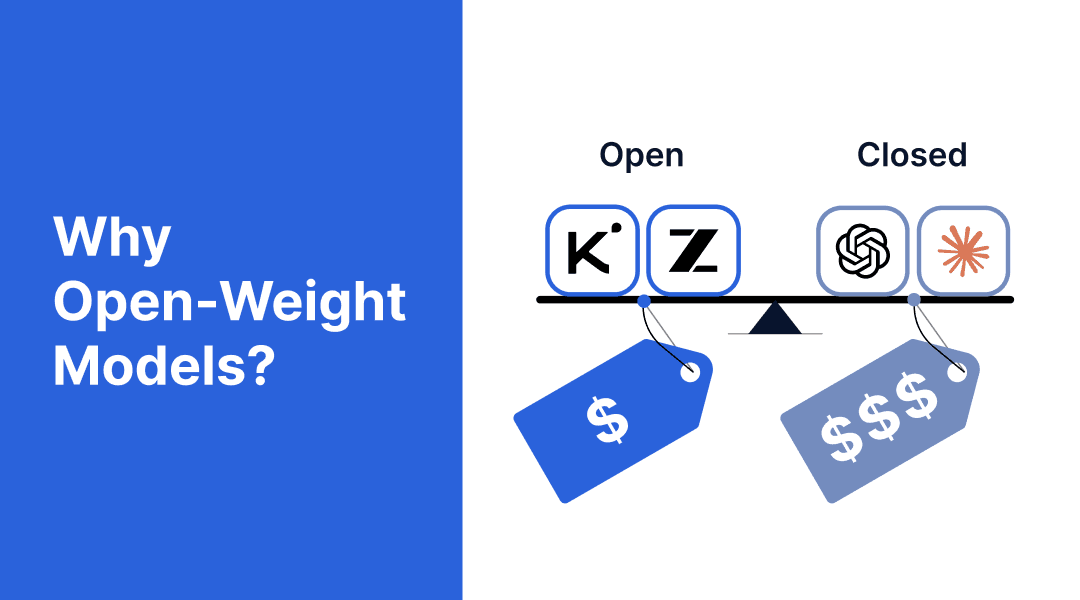
Open-weight models such as GLM-5.3 and Kimi K3 can offer better value than Astra or Fable when they meet a workload’s quality requirements at a lower cost. We evaluated 12 configurations of nine models on SWE-bench Verified and Terminal-Bench 2.1, comparing accuracy, mean cost per task, completion time, and task-level behavior. On SWE-bench Verified, GLM-5.3-Flash achieved 89.6% accuracy at approximately $0.02 per task, compared with Astra’s 87.0% at $1.00. GLM-5.3 reached 94.2% at $0.18, while Kimi K3 reached 93.8% at $0.77. The picture changes on Terminal-Bench 2.1, where Astra and Fable were more accurate than Kimi K3, though still more expensive per task.
Aggregate benchmark scores hide as much as they show, so we also break down the results by problem type to highlight models’ relative strengths. We also compare output quality across four design tasks, examining how models translate the same requirements into different visual and interactive experiences. Together, these comparisons show where GLM-5.3 and Kimi K3 match or beat Astra and Fable, and where a proprietary model’s advantages still justify its price. For application builders, the goal is not to pick a universal winner, but to find the model that meets a specific workload’s quality, cost, and speed requirements.
Recreating Manhattan with GLM-5.3 and Astra
Figure 1. First-person flight animations by GPT-6 Astra (left) and GLM-5.3 (right).
A model’s capabilities are easier to appreciate through the work it produces. We asked GPT-6 Astra and GLM-5.3 to recreate Midtown Manhattan in Blender and animate a first-person flight between its buildings, inspired by Spider-Man’s movement through New York. We used Kilo Code as the agent harness for both models. The task demands 3D modeling, scene composition, and camera animation at once. The animations show how each model interpreted and built the scene.
The still images reveal differences in modeling detail. GLM-5.3 captured the overall structure through a dense skyline, varied building heights, and long street corridors. Astra produced more consistent architectural detail, particularly in window placement and road markings. GLM demonstrated strong scene-building capability, while Astra delivered a more polished result.
This example makes GLM-5.3 worth considering for demanding work. To examine the practical trade-offs more systematically, we next compare open- and closed-weight models on coding benchmarks, measuring accuracy, cost per task, and completion time.
Accuracy, Cost, and Speed Favor Different Models
We evaluated 12 configurations of nine models using mini-swe-agent for 500 SWE-bench Verified tasks and Terminus 2 for 89 Terminal-Bench 2.1 tasks. For each configuration, we compared accuracy, mean cost per task, and median completion time. When provider guardrails blocked a task, Fable, Astra, and GPT-5.6 Sol fell back to a secondary model, and we include those results below.
Figure 3. Accuracy, cost, and time per task across SWE-bench Verified and Terminal-Bench 2.1. Compares open and closed-weight models across three dimensions of coding-agent performance: benchmark accuracy, mean cost per task, and mean completion time per task, showing the trade-off between solution quality and execution efficiency. We report results for both SWE-bench Verified and Terminal-Bench 2.1. Due to guardrails, Claude Fable 5.1, GPT-5.6-sol, and GPT-6-astra use fallback models.
Fable achieved the highest accuracy on both benchmarks, but open-weight models offered strong alternatives at lower cost. On SWE-bench Verified, GLM-5.3 reached 94.2% accuracy at a mean cost of $0.18 per task, compared with Fable’s 97.8% at $2.70. For workloads where that accuracy difference is acceptable, GLM-5.3 offers a substantial reduction in inference cost.
GLM-5.3-Flash provided another compelling option. It achieved 89.6% accuracy at approximately $0.02 per task, above Astra’s 87.0% at $1.00; here, the cheaper model also solved more tasks. Completion time adds another consideration. On Terminal-Bench 2.1, GLM-5.3 outperformed Astra on accuracy (86.5% to 85.4%) but took a median 20.36 minutes per task versus Astra’s 3.63 minutes. A workload that tolerates longer execution may favor GLM’s accuracy and cost, while one that requires faster responses may favor Astra.
Figure 4 brings accuracy and cost into the same view, making it easier to identify configurations that deliver stronger results within a given budget.
Figure 4. Accuracy versus mean cost per task on SWE-bench Verified and Terminal-Bench 2.1. Each point represents a model configuration. Points farther toward the upper left combine higher accuracy with lower cost. The cost axis uses a logarithmic scale.
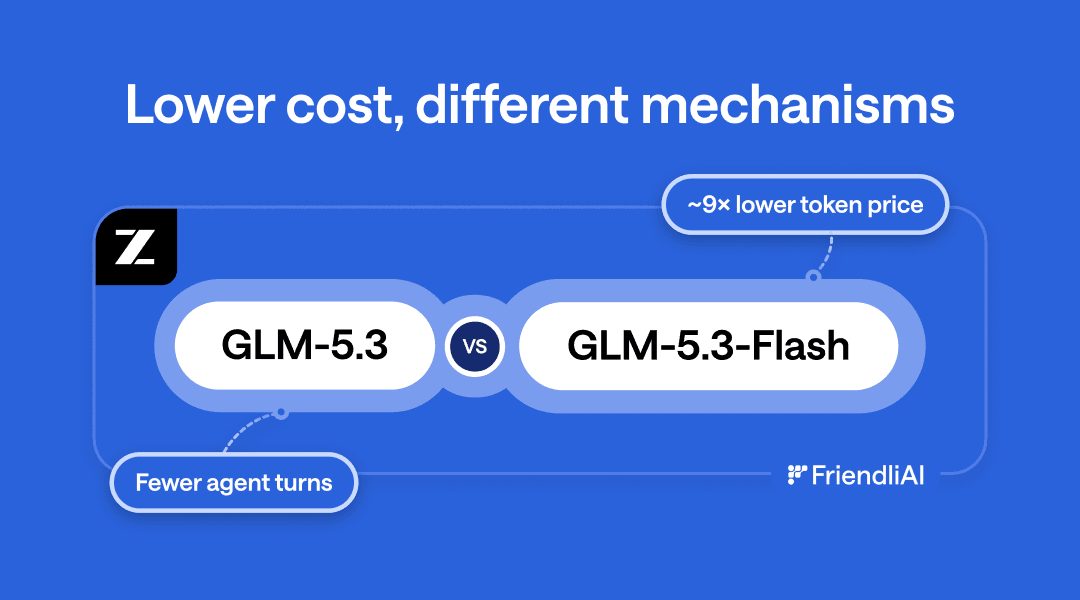
GLM-5.3-Flash and GLM-5.3 offer two compelling options. On SWE-bench Verified, Flash achieved 89.6% accuracy at approximately $0.02 per task, compared with Astra’s 87.0% at $1.00. In this evaluation, the cheaper configuration also solved more tasks. GLM-5.3 reached higher accuracy at 94.2%, with a mean cost of $0.18 per task, compared with Fable’s 97.8% at $2.70. Fable’s accuracy advantage also came with a higher measured cost on Terminal-Bench. It achieved 92.1% accuracy at a mean cost of $65.53 per task, compared with GLM-5.3’s 86.5% at $0.79. For a closer look at when each fits, see GLM-5.3 vs. GLM-5.3-Flash.
Similar Scores Hide Different Strengths
Figure 5. Pairwise model comparison across SWE-bench Verified and Terminal-Bench 2.1. Compares two models directly on accuracy, cost per task, and time per task, and shows how many benchmark tasks both models solved versus only one.
Kimi K3 and GPT-6 Astra illustrate how the preferred model flips with the workload. On SWE-bench Verified, Kimi achieved higher accuracy than Astra (93.8% versus 87.0%) at a lower mean cost per task ($0.77 versus $1.00). However, its median completion time was more than twice as long, 7.78 minutes versus 3.27 minutes. On Terminal-Bench 2.1, the ranking reversed: Astra was more accurate (85.4% versus Kimi’s 80.9%) and faster (3.63 minutes versus 7.23 minutes), while Kimi stayed cheaper at $0.57 per task against Astra at $1.33. Kimi therefore offered the stronger accuracy-cost combination on SWE-bench, while the Terminal-Bench posed a clearer trade-off between Kimi’s lower cost and Astra’s higher accuracy and speed.
Figure 6. Domain-level head-to-head comparison across SWE-bench Verified and Terminal-Bench 2.1. Breaks down model performance by problem category and shows how many tasks each model solved uniquely, along with the total number of tasks in each category.
GLM-5.3 and GPT-5.6 Sol, both at maximum reasoning effort, illustrate how similar aggregate scores can conceal different strengths. On Terminal-Bench 2.1, they solved 77 and 76 of 89 tasks, respectively. Both solved 67 tasks, while GLM solved 10 that Sol missed and Sol solved nine that GLM missed. A one-task gap in total successes was hiding 19 tasks where the two models disagreed.
Breaking the results down by category locates those differences. On SWE-bench Verified, GLM-5.3 solved 33 of 37 parsing tasks versus Sol’s 31; Sol took rendering and visual problems, solving all 66 to GLM’s 62, and also led on tracing and compatibility problems. On Terminal-Bench, GLM solved 15 of 16 ML tasks to Sol’s 13, while Sol solved seven of eight science tasks compared to GLM’s five. Both solved 36 of 41 software tasks, although their successful task sets differed. The practical lesson is to choose evaluation tasks that look like your own.
Figure 7. Distribution of time and token usage per task across models. Compares time per task, input tokens, output tokens, and total tokens across SWE-bench Verified and Terminal-Bench 2.1. Each point represents an individual task, while the distribution and median highlight differences in typical usage, variability, and long-tail behavior across models.
A pass-or-fail score also leaves out what each attempt cost in time and tokens. The distributions show both typical resource use alongside the long tails, where individual tasks consumed far more than the median. Two models with matching accuracy can therefore place very different demands on an execution budget and a response-time target.
Taken together, these breakdowns do what an aggregate score cannot: task overlap shows where models succeed differently, domain results tie those differences to a real workload, and resource distributions expose variability an average hides. All of it, though, rests on tasks with defined success criteria. Open-ended design has none. We turn there next, where a model has to interpret a brief and decide on visual presentation, information hierarchy, and interaction. Comparing those finished experiences reveals another set of capabilities that benchmark accuracy alone does not capture.
Open-Weight Models Deliver Competitive Design Results
In our design experiments, GLM-5.3 and Kimi K3 turned open-ended briefs into coherent visual and interactive experiences. Models often converged on similar design directions; differences showed up in visual refinement, information presentation, and interaction quality.
We ran four website-design tasks covering transit information, brand identity, interactive typography, and a Steam redesign. For each, the participating models received the same brief and supporting materials in separate sandboxes, then worked without further human direction. All four tasks used Kilo Code as the agent harness. The comparisons that follow are qualitative.
Figure 8. Model-generated website demos for the San Francisco transit information-design task. Compares how Claude Fable 5.1, Kimi K3, GPT-6 Astra, and GLM-5.3 transformed the same transit dataset into interactive interfaces, revealing different approaches to information hierarchy, navigation, data density, and visualization.
The transit task asked models to turn 358KB of San Francisco transit data into a useful interface. Astra, Fable, GLM-5.3, and Kimi K3 organized it around routes, stations, and transit modes, arriving at broadly comparable information structures. Fable and Astra surfaced more detail in the overview, while GLM labeled station names clearly on its map. Kimi required more navigation to reach some information. The gap wasn't in the approach, but in how quickly a user could find what they wanted.
Figure 9. Model-generated website demos for the Himalayan chili oil brand-design task. Compares how GPT-6 Astra, Claude Fable 5.1, Kimi K3, and GLM-5.3 translated the same product brief and supporting materials into distinct brand identities and website experiences.
The Himalayan Harvest task pushed all four models in the same visual direction: warm colors, expressive typography, and storytelling around ingredients and origin. Kimi K3 and GLM-5.3 built coherent brand identities that stayed consistent with the brief. Astra and Fable produced more refined product imagery and illustration, adding an extra layer of polish to their pages.
Figure 10. Model-generated website demos for the interactive design task. Compares how GPT-6 Astra, Claude Fable 5.1, and Kimi K3 interpreted the same open-ended brief to create an experimental digital experience using typography, 3D elements, motion, and interaction.
On the interactive typography task, Kimi K3 delivered the core interactive experience the prompt asked for, including 3D interaction, particles, rotation, zoom, and motion. Astra and Fable had the edge in refinement, particularly in lighting, material quality, and how natural the interactions felt. But Kimi implemented the requested experience end to end rather than dropping major parts of the brief, at a total generation cost of $1.66.
Figure 11. Model-generated website demos for the Steam UX redesign task. Compares how Kimi K3, Claude Fable 5.1, and GPT-6 Astra redesigned the same product based on a shared brief and user feedback, with different approaches to navigation, content organization, discovery, and visual hierarchy.
Kimi K3’s Steam redesign balanced information density with a clear browsing structure. Prominent game artwork, prices, review data, and navigation supported exploration while keeping the page easy to scan. Fable’s interface was denser. For a storefront built around discovering and comparing games, Kimi’s balance of detail and readability was the more effective choice. Across these examples, GLM-5.3 and Kimi K3 proved capable of practical design work. Together with the benchmark results, that is a concrete reason to put open-weight models in your evaluation set.
The Right Model Depends on the Workload
GLM-5.3, GLM-5.3-Flash, and Kimi K3 belong in the same conversation as Astra and Fable. In our SWE-bench Verified evaluation, all three were more accurate than Astra at a lower mean cost per task. The task-level comparisons showed that models with near-identical scores solve different problems, and the creative examples showed GLM and Kimi turning demanding briefs into coherent visual and interactive work. The proprietary models kept meaningful advantages. Fable was the most accurate on both coding benchmarks, while Astra was faster than GLM-5.3 and Kimi K3.
Model rankings also keep changing as new models arrive. Play the timeline below to watch new releases enter the comparison and reorder the ranking, then switch benchmarks to see how the order changes again. Different metrics and cost tiers bring different models to the top. Try following GLM, Kimi, or another model family through the timeline.
Figure 12. Intelligence–cost frontier across leading language models. The figure compares models by Artificial Analysis Intelligence Index and total evaluation cost, grouped into ≤$1K, $1K–$3K, and $3K+ cost bands. Rankings are reconstructed by model release date using Artificial Analysis scores and costs captured on September 10, 2026.
When an open-weight model delivers the quality your workload needs at an acceptable speed, its lower inference cost can make it the better choice. GLM-5.3, GLM-5.3-Flash, and Kimi K3 give you concrete reasons to test that possibility. Define the quality and completion-time requirements they must meet, run candidates on representative tasks from your application, and compare the cost of achieving those outcomes.
Try GLM-5.3 and GLM-5.3-Flash through FriendliAI Model APIs and evaluate them on your own workloads. Compare output quality, cost per task, and completion time to find the model that fits your application. → Get started with FriendliAI
Written by
FriendliAI Tech & Research
Share
General FAQ
Still have questions?
If you want a customized solution for that key issue that is slowing your growth, support@friendli.ai or click Talk to an engineer — our engineers (not a bot) will reply within one business day.