How Liner Scholar Cut LLM Cost up to 30% by Moving from Closed Models to GLM with FriendliAI

Overview
Liner builds AI search agents and research experiences that help users find, understand, and work with information more efficiently. This story focuses on Liner Scholar, Liner's dedicated AI research agent. Behind those experiences are inference-heavy workloads that require models to process a large volume of requests while maintaining the quality and responsiveness users expect.
As Liner's AI workloads grew, relying primarily on closed models created a growing cost challenge. The team began evaluating open-weight models as an alternative, looking for a way to reduce inference costs without compromising the model quality required for real-world AI workflows.
Liner identified GLM as a promising open-model alternative, but model choice was only part of the equation. With a growing volume of inference requests, the team also needed a serving provider that could deliver the model with the speed and responsiveness required for production workloads.
FriendliAI ranked #1 for GLM on OpenRouter's live production traffic benchmarks across throughput, time-to-first-token, and end-to-end latency. That performance made FriendliAI a strong candidate as Liner looked to scale its open-model workloads without compromising responsiveness.
Impact Highlights:
- #1 GLM provider on OpenRouter across throughput, time-to-first-token, and end-to-end latency during the benchmark period
- FriendliAI selected for inference optimization testing, with the goal of improving GLM serving performance for production-scale workloads
- ~30% lower LLM cost per turn in Liner Scholar after moving from a closed model to GLM on FriendliAI, measured in an online A/B test
- ~25% lower average response time per turn in Liner Scholar, from question received to answer completed, measured in the same A/B test
Challenges
Keeping inference fast as AI workloads scale
For an AI product like Liner, growth means more than simply serving more users. Each user request can trigger reasoning, retrieval, synthesis, and other model-intensive operations, creating a rapidly growing volume of inference traffic behind the product.
As that volume increased, Liner faced two related challenges. Relying primarily on closed models meant inference costs grew alongside usage, prompting the team to explore open-weight alternatives that could deliver better economics without compromising the quality required for production workloads. But adopting an open model was only part of the challenge: Liner also needed to ensure that growing traffic did not come at the expense of inference speed.
For a user-facing AI product, serving performance is part of the product experience itself. A model may produce high-quality outputs, but if requests take too long to process, users still experience a slower product. As concurrent traffic increases, the inference layer must continue delivering high throughput and low latency at scale.
This became particularly important as Liner expanded its use of GLM. While the model met the team's workload requirements, its production performance would ultimately depend on how efficiently it was served, making it essential to have an inference provider capable of delivering the speed and scalability required for Liner's growing workloads.
The Solution
Moving to a more cost-efficient open model
Liner began by evaluating open-weight models that could offer better economics than the closed models it had been using, without compromising the quality required for its production workloads.
Rather than relying only on general-purpose benchmarks, the team tested GLM against its own workloads and found that it could deliver the level of task quality Liner needed while offering a more favorable cost structure.
But selecting a more cost-efficient model was only the first step. To realize those economics at production scale, Liner also needed to serve GLM efficiently as request volume continued to grow.
Serving GLM faster with FriendliAI
That is where FriendliAI became a critical part of the stack.
FriendliAI's inference engine is built for high-throughput production workloads, using technologies such as continuous batching and memory optimization to process concurrent requests efficiently and maximize GPU utilization.
For Liner, faster and more efficient serving meant that the benefits of moving to an open model could extend beyond model pricing alone. Higher throughput allowed more requests to be processed over the same period, while lower latency helped maintain a responsive user experience as traffic increased.
By pairing GLM with FriendliAI's optimized inference infrastructure, Liner could improve both the economics and performance of its production workloads.
From evaluation to production inference
Following its evaluation, Liner began gradually integrating FriendliAI Model APIs into Liner Scholar's production inference workloads, expanding adoption as the team validated performance through an online A/B test.
FriendliAI now serves GLM as part of Liner's production stack, helping the team support growing request volumes with the high-throughput, low-latency inference required at scale.
Results
Liner now uses FriendliAI as part of its production AI stack, giving the team a high-performance inference layer designed to support growing request volumes.
In an online A/B test on Liner Scholar comparing its previous closed model with GLM served on FriendliAI, Liner reduced LLM cost per turn by approximately 30%. In the same test, average response time per turn, measured from when a question is received until the answer is complete, dropped by about 25%, giving Liner Scholar the serving performance needed to run those workloads efficiently at production scale.
For Liner, the result is a more efficient AI stack that combines the economics and flexibility of open models with the speed and scalability of FriendliAI's inference infrastructure.
As Liner continues to grow, FriendliAI provides the infrastructure layer to help that growth translate into more inference capacity, not longer wait times.
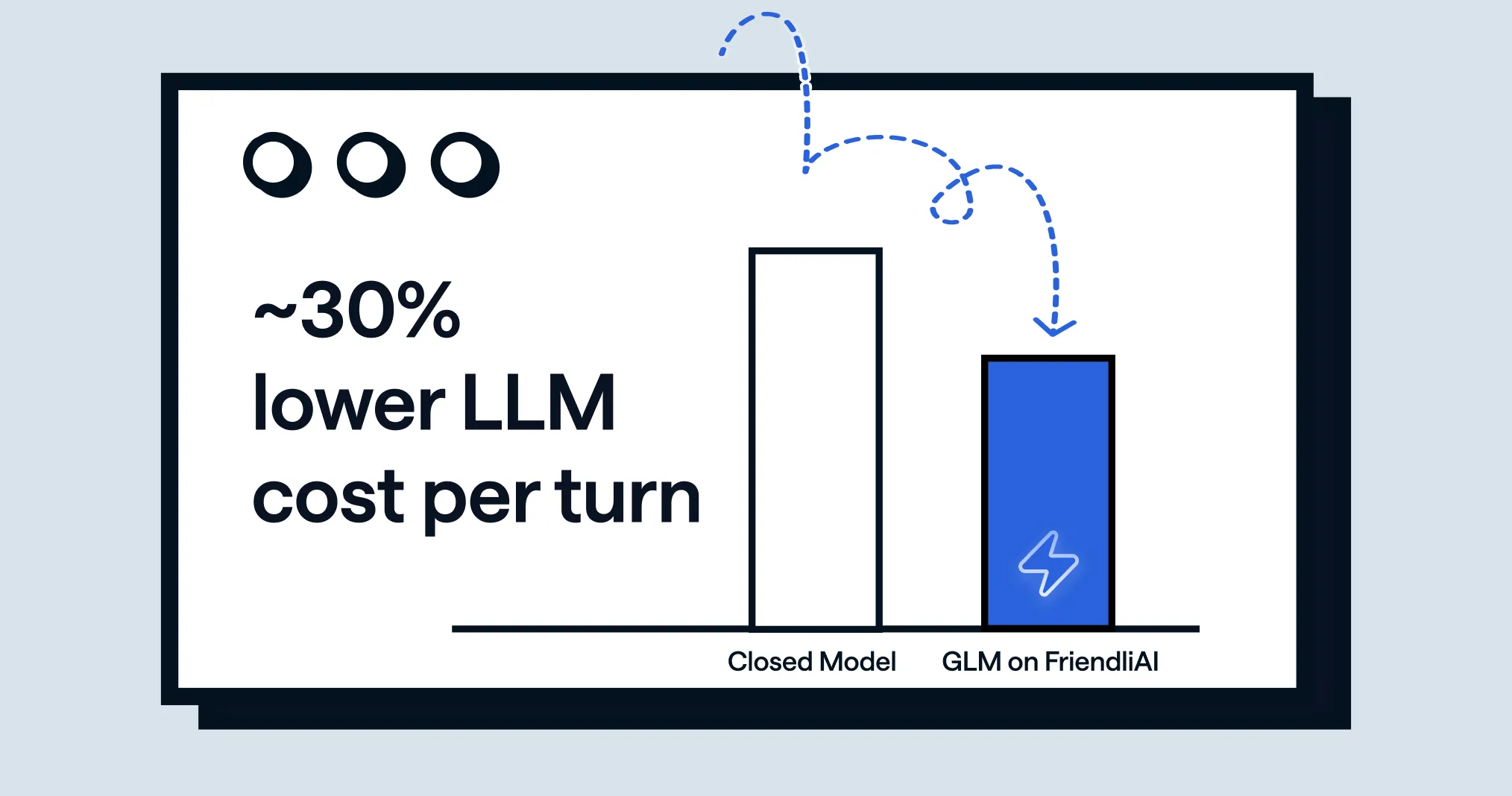
“As our AI workloads grew, inference performance became increasingly important to the user experience. When we moved Liner Scholar from a closed model to GLM on FriendliAI, we saw about 30% lower LLM cost per turn and about 25% lower average response time per turn. FriendliAI gives us a high-performance way to run GLM as part of our production stack.”
Liner team

Deploy Your Models with FriendliAI
FriendliAI helps AI companies and enterprise teams turn foundation models into reliable production systems with optimized inference, autoscaling, and the operational resilience that customer-facing services demand.
Serve high-performance inference with FriendliAI.
Start Building Faster
Related Customer Stories
Learn how leading companies achieve unmatched performance, scalability, and reliability with FriendliAI
FriendliAI was consistently 7 times faster and had a significantly lower error rate.

Our custom model API went live in about a day with enterprise-grade monitoring built in.

Rock-solid reliability with ultra-low tail latency.

Fluctuating traffic is no longer a concern because autoscaling just works.

Scale to trillions of tokens with 50% fewer GPUs, thanks to FriendliAI.

FriendliAI was consistently 7 times faster and had a significantly lower error rate.
Our custom model API went live in about a day with enterprise-grade monitoring built in.
Rock-solid reliability with ultra-low tail latency.
Fluctuating traffic is no longer a concern because autoscaling just works.
Scale to trillions of tokens with 50% fewer GPUs, thanks to FriendliAI.